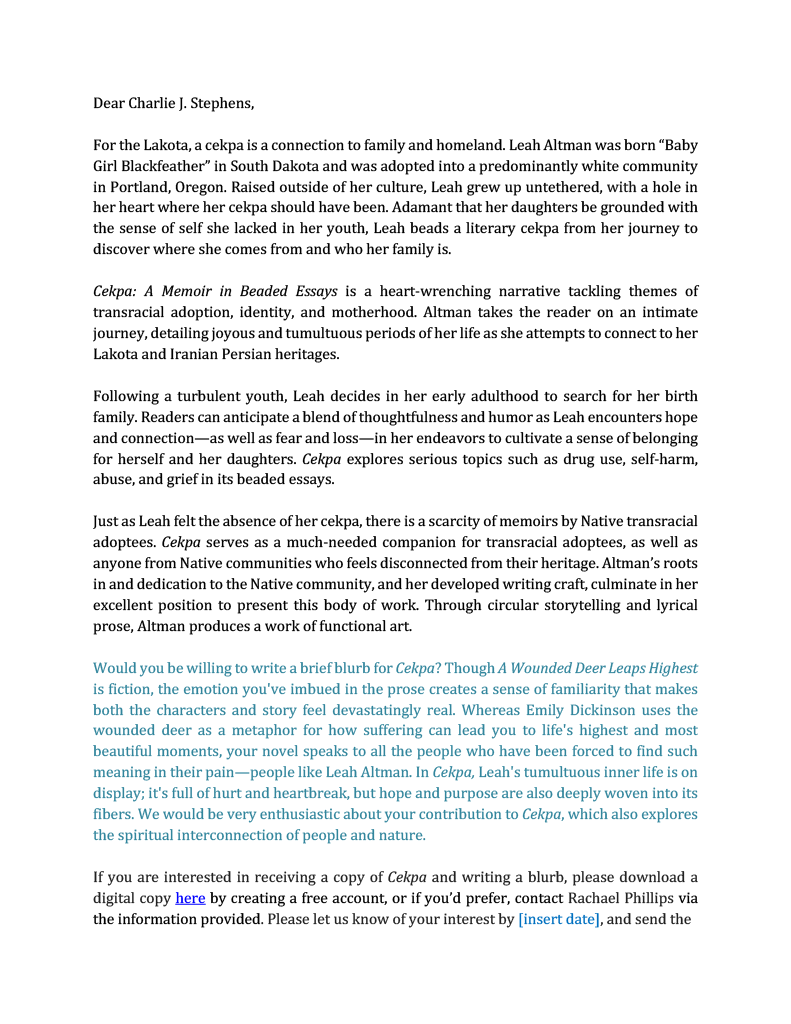
Front Image: “Dear Charlie J. Stephens,
For the Lakota, a cekpais a connection to family and homeland. Leah Altman was born “Baby Girl Blackfeather” in South Dakota and was adopted into a predominantly white community in Portland, Oregon. Raised outside of her culture, Leah grew up untethered, with a hole in her heart where her cekpa should have been. Adamant that her daughters be grounded with the sense of self she lacked in her youth, Leah beads a literary cekpa from her journey to discover where she comes from and who her family is.
Cekpa: A Memoir in Beaded Essays is a heart-wrenching narrative tackling themes of transracial adoption, identity, and motherhood. Altman takes the reader on an intimate journey, detailing joyous and tumultuous periods of her life as she attempts to connect to her Lakota and Iranian Persian heritages.
Following a turbulent youth, Leah decides in her early adulthood to search for her birth family. Readers can anticipate a blend of thoughtfulness and humor as Leah encounters hope and connection—as well as fear and loss—in her endeavors to cultivate a sense of belonging for herself and her daughters. Cekpa explores serious topics such as drug use, self-harm, abuse, and grief in its beaded essays.
Just as Leah felt the absence of her cekpa, there is a scarcity of memoirs by Native transracial adoptees. Cekpa serves as a much-needed companion for transracial adoptees, as well as anyone from Native communities who feels disconnected from their heritage. Altman’s roots in and dedication to the Native community, and her developed writing craft, culminate in her excellent position to present this body of work. Through circular storytelling and lyrical prose, Altman produces a work of functional art.
Would you be willing to write a brief blurb for Cekpa? Though A Wounded Deer Leaps Highest is fiction, the emotion you’ve imbued in the prose creates a sense of familiarity that makes both the characters and story feel devastatingly real. Whereas Emily Dickinson uses the wounded deer as a metaphor for how suffering can lead you to life’s highest and most beautiful moments, your novel speaks to all the people who have been forced to find such meaning in their pain—people like Leah Altman. In Cekpa, Leah’s tumultuous inner life is on display; it’s full of hurt and heartbreak, but hope and purpose are also deeply woven into its fibers. We would be very enthusiastic about your contribution to Cekpa, which also explores the spiritual interconnection of people and nature.If you are interested in receiving a copy of Cekpa and writing a blurb, please download a digital copy here by creating a free account, or if you’d prefer, contact Rachael Phillips via the information provided. Please let us know of your interest by [insert date], and send the . . .
Back image:
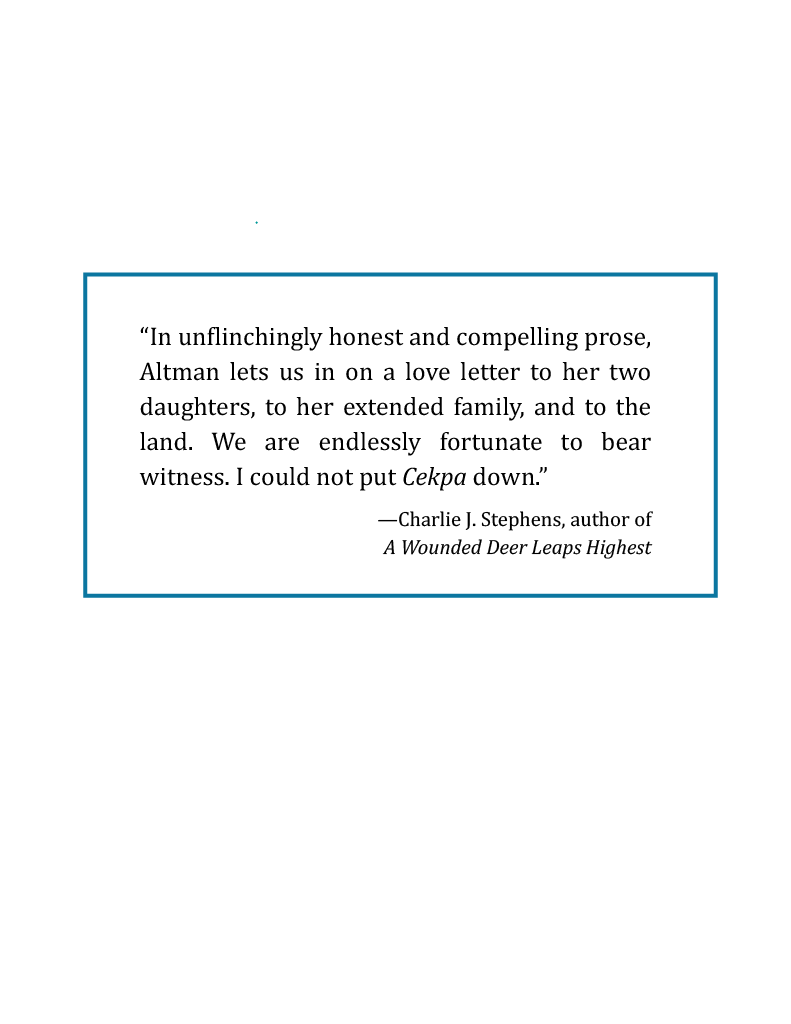
“In unflinchingly honest and compelling prose, Altman lets us in on a love letter to her two daughters, to her extended family, and to the land. We are endlessly fortunate to bear witness. I could not put Cekpa down.” —Charlie J. Stephens, author of A Wounded Deer Leaps Highest
Front image:
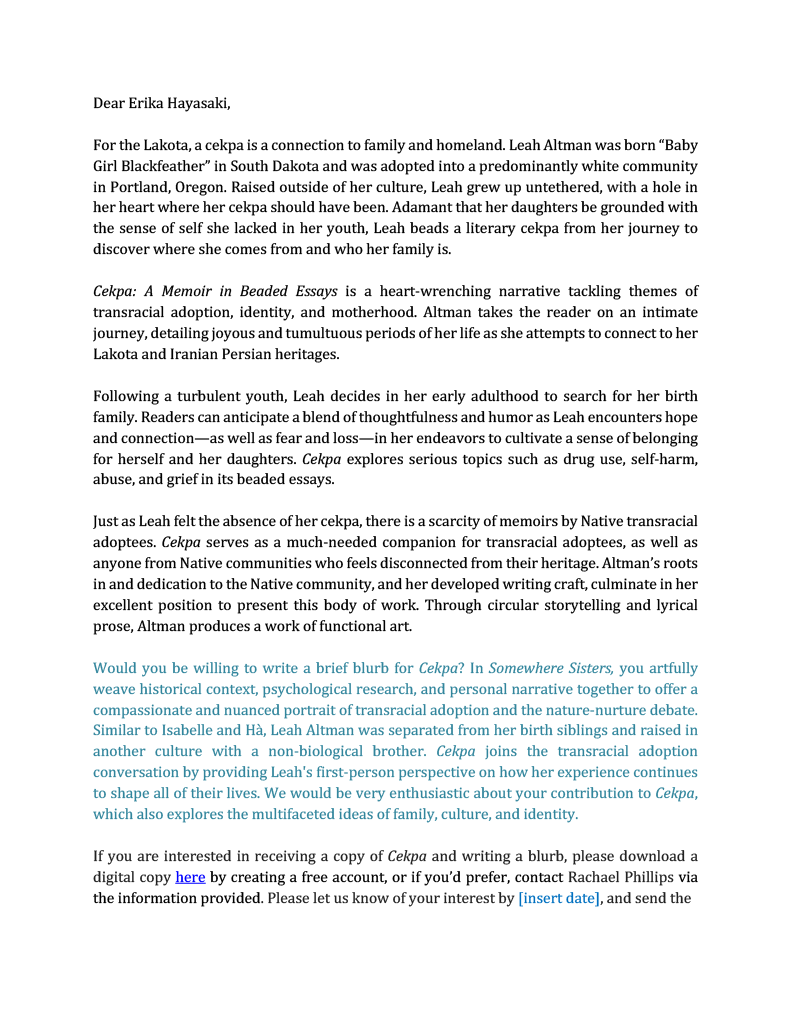
Dear Erika Hayasaki,
For the Lakota, a cekpais a connection to family and homeland. Leah Altman was born “Baby Girl Blackfeather” in South Dakota and was adopted into a predominantly white community in Portland, Oregon. Raised outside of her culture, Leah grew up untethered, with a hole in her heart where her cekpa should have been. Adamant that her daughters be grounded with the sense of self she lacked in her youth, Leah beads a literary cekpa from her journey to discover where she comes from and who her family is.
Cekpa: A Memoir in Beaded Essays is a heart-wrenching narrative tackling themes of transracial adoption, identity, and motherhood. Altman takes the reader on an intimate journey, detailing joyous and tumultuous periods of her life as she attempts to connect to her Lakota and Iranian Persian heritages.
Following a turbulent youth, Leah decides in her early adulthood to search for her birth family. Readers can anticipate a blend of thoughtfulness and humor as Leah encounters hope and connection—as well as fear and loss—in her endeavors to cultivate a sense of belonging for herself and her daughters. Cekpa explores serious topics such as drug use, self-harm, abuse, and grief in its beaded essays.
Just as Leah felt the absence of her cekpa, there is a scarcity of memoirs by Native transracial adoptees. Cekpa serves as a much-needed companion for transracial adoptees, as well as anyone from Native communities who feels disconnected from their heritage. Altman’s roots in and dedication to the Native community, and her developed writing craft, culminate in her excellent position to present this body of work. Through circular storytelling and lyrical prose, Altman produces a work of functional art.
Would you be willing to write a brief blurb for Cekpa? In Somewhere Sisters, you artfully weave historical context, psychological research, and personal narrative together tooffer a compassionate and nuanced portrait of transracial adoption and the nature-nurture debate. Similar to Isabelle and Hà, Leah Altman was separated from her birth siblings and raised in another culture with a non-biological brother. Cekpa joins the transracial adoption conversation byproviding Leah’s first-person perspective on how her experience continues to shape all of their lives. We would be very enthusiastic about your contribution to Cekpa, which also explores the multifaceted ideas of family, culture, and identity.
If you are interested in receiving a copy of Cekpa and writing a blurb, please download a digital copy here by creating a free account, or if you’d prefer, contact Rachael Phillips via the information provided. Please let us know of your interest by [insert date], and send the . . .
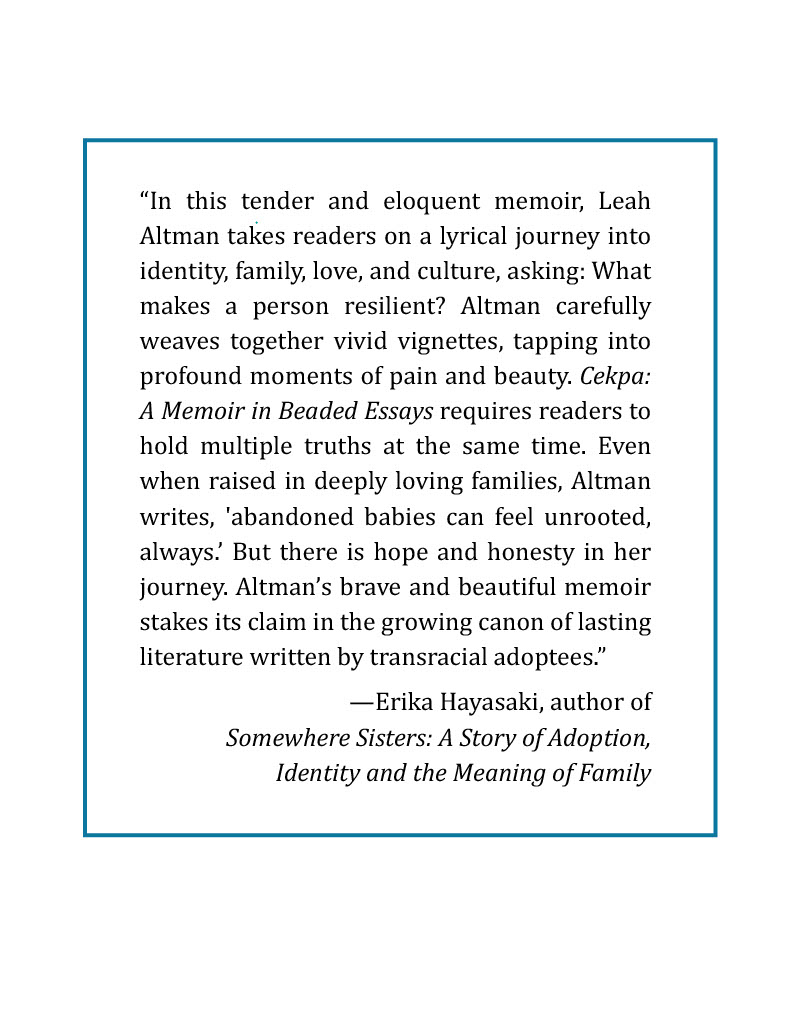
Back Image:“In this tender and eloquent memoir, Leah Altman takes readers on a lyrical journey into identity, family, love, and culture, asking: What makes a person resilient? Altman carefully weaves together vivid vignettes, tapping into profound moments of pain and beauty. Cekpa: A Memoir in Beaded Essays requires readers to hold multiple truths at the same time. Even when raised in deeply loving families, Altman writes, ‘abandoned babies can feel unrooted, always.’ But there is hope and honesty in her journey. Altman’s brave and beautiful memoir stakes its claim in the growing canon of lasting literature written by transracial adoptees.” —Erika Hayasaki, author of
Somewhere Sisters: A Story of Adoption, Identity and the Meaning of Family
Front Image:
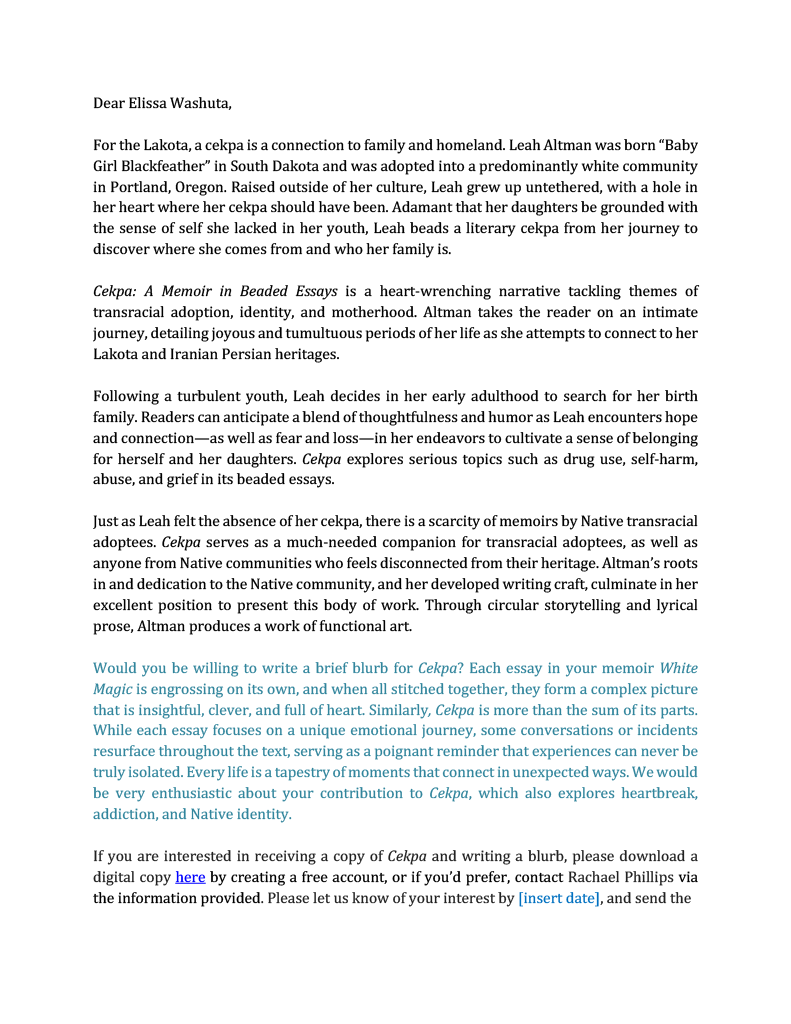
Dear Elissa Washuta,
For the Lakota, a cekpais a connection to family and homeland. Leah Altman was born “Baby Girl Blackfeather” in South Dakota and was adopted into a predominantly white community in Portland, Oregon. Raised outside of her culture, Leah grew up untethered, with a hole in her heart where her cekpa should have been. Adamant that her daughters be grounded with the sense of self she lacked in her youth, Leah beads a literary cekpa from her journey to discover where she comes from and who her family is.
Cekpa: A Memoir in Beaded Essays is a heart-wrenching narrative tackling themes of transracial adoption, identity, and motherhood. Altman takes the reader on an intimate journey, detailing joyous and tumultuous periods of her life as she attempts to connect to her Lakota and Iranian Persian heritages.
Following a turbulent youth, Leah decides in her early adulthood to search for her birth family. Readers can anticipate a blend of thoughtfulness and humor as Leah encounters hope and connection—as well as fear and loss—in her endeavors to cultivate a sense of belonging for herself and her daughters. Cekpa explores serious topics such as drug use, self-harm, abuse, and grief in its beaded essays.
Just as Leah felt the absence of her cekpa, there is a scarcity of memoirs by Native transracial adoptees. Cekpa serves as a much-needed companion for transracial adoptees, as well as anyone from Native communities who feels disconnected from their heritage. Altman’s roots in and dedication to the Native community, and her developed writing craft, culminate in her excellent position to present this body of work. Through circular storytelling and lyrical prose, Altman produces a work of functional art.
Would you be willing to write a brief blurb for Cekpa? Each essay in your memoir White Magic is engrossing on its own, and when all stitched together, they form a complex picture that is insightful, clever, and full of heart. Similarly, Cekpa is more than the sum of its parts. While each essay focuses on a unique emotional journey, some conversations or incidents resurface throughout the text, serving as a poignant reminder that experiences can never be truly isolated. Every life is a tapestry of moments that connect in unexpected ways. We would be very enthusiastic about your contribution to Cekpa, which also explores heartbreak, addiction, and Native identity.
If you are interested in receiving a copy of Cekpa and writing a blurb, please download a digital copy here by creating a free account, or if you’d prefer, contact Rachael Phillips via the information provided. Please let us know of your interest by [insert date], and send the
Back Image:
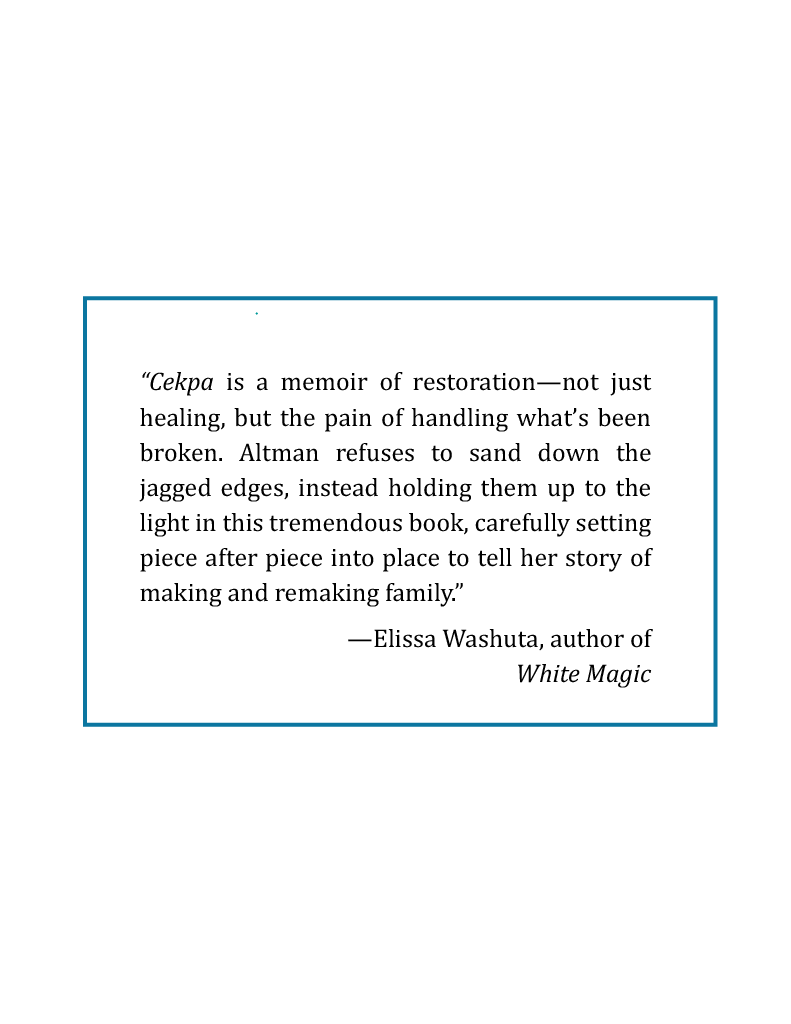
“Cekpa is a memoir of restoration—not just healing, but the pain of handling what’s been broken. Altman refuses to sand down the jagged edges, instead holding them up to the light in this tremendous book, carefully setting piece after piece into place to tell her story of making and remaking family.” —Elissa Washuta, author of White Magic